

• About Us
  • Society
  • Health
  • Technology
  • Culture
  • World
  • Entertainment
  • Competition
The Pioneer Magazine
  • About Us
    • WRITE WITH US
  • Society
  • Health
  • Technology
  • Culture
  • World
  • Entertainment
  • Competition

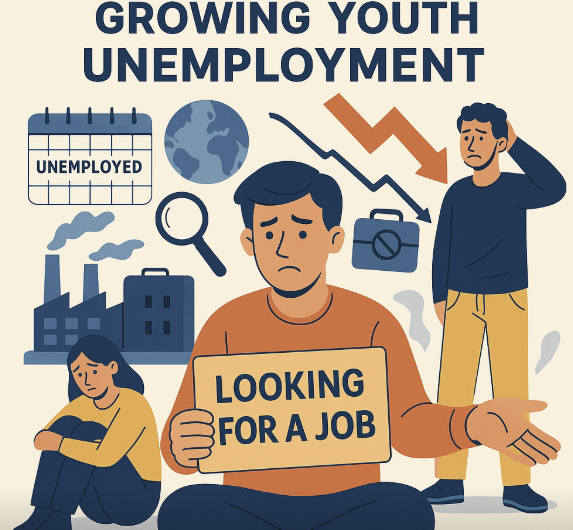
About Youth Unemployment

Posted by Editor on May 31st, 2025

The issue of youth unemployment has been around for decades, but in recent years, it feels like it’s taken on a new level of urgency. Everywhere you look—whether it’s in developed countries with strong economies or in developing nations trying to grow—young people are struggling to find jobs that match their skills, education, or even their hopes. What makes this problem particularly worrying is that it doesn’t just affect individual lives; it shapes entire generations’ outlooks on stability, ambition, and trust in the system.

One reason youth unemployment has grown so widespread is the mismatch between education and the job market. Schools and universities often emphasize theory, while employers look for experience. You can have a degree, sometimes even an advanced one, but still not qualify for a job because you’ve never “done it” in the real world. That’s a frustrating paradox—how are you supposed to gain experience if nobody hires you in the first place? In some places, this has led to what people call “over-education but underemployment,” where graduates end up working in positions far below their skill level or outside their field entirely.

Technology has also made things more complicated. On one hand, it’s opened up new industries—think of app development, e-commerce, or digital marketing—that didn’t exist twenty years ago. But it’s also made some traditional jobs obsolete. Automation and artificial intelligence are replacing tasks that used to be done by entry-level workers. Companies can run with fewer employees, and that usually means young people, who are just entering the workforce, have fewer spots available. The result is a strange contradiction: there are more career options than ever before, yet finding a good one feels harder than ever.

Economic uncertainty plays another big part. Events like the COVID-19 pandemic have thrown entire job markets off balance. Industries such as tourism, hospitality, and retail—where young people often find their first jobs—were hit the hardest. Even as economies reopen, companies are cautious about hiring. They want to cut costs and avoid taking risks, and that means fewer opportunities for recent graduates. In countries with weak social safety nets, this can push young people into unstable or informal jobs, gig work, or even unemployment that lasts years.

But beyond the numbers and statistics, youth unemployment takes a toll on people’s sense of purpose. It can feel deeply personal. For many young adults, work isn’t just a paycheck—it’s about independence, identity, and belonging. When that’s missing, it can lead to anxiety, frustration, or even social unrest. Some young people respond by moving abroad, chasing opportunities in other countries; others try to create their own, starting small businesses or freelancing online. In that sense, this generation is also incredibly resourceful and adaptable, finding new paths even when the old ones are blocked.

There’s no single fix to this problem, but a few ideas could help. Schools could partner more closely with industries to offer practical experience early on—internships, apprenticeships, and hands-on projects. Governments could invest in green jobs, creative industries, and tech training to match the future economy. And maybe, as a society, we need to rethink what “success” looks like for young people—not just a 9-to-5 job, but meaningful work that allows them to grow, contribute, and live with dignity.

Youth unemployment might be a global issue, but it’s also a personal one that affects millions of individual stories. The challenge for our generation isn’t just finding jobs—it’s redefining what work means in a world that’s changing faster than ever.

Andrew Ohn

Read More »

Gandhi’s Philosophy in Global Reflection

Posted by Editor on May 2nd, 2025

Gandhi’s Philosophy in Global Reflection

Feiyu Lin


Mohandas Karamchand Gandhi, generally recognized as India’s Father of the Nation, is a powerful symbol of world peace and justice. Gandhi, whom poet Rabindranath Tagore labeled “Mahatma” or “Great Soul,” founded the world-renowned theory of nonviolent resistance and civil disobedience. His ideas not only greatly influenced India’s independence battle, but they also spread globally through his philosophy’s primary concepts of nonviolence (Ahimsa), truth (Satya), and universal welfare (Sarvodaya). As noted in a report from “The Times of India” on October 2, 2024, on Gandhi’s birth anniversary, October 2, 2024: “Gandhi is a thought. Even if you want to criticize him, you have to first read him. He’s a philosopher. He was not just randomly naked on roads. There was a philosophy behind his actions.”(TOI Lifestyle Desk, 2024) These themes in his philosophy continue to inspire social movements and promote cultural awareness even now.

By comparing Gandhi’s writings and their interpretation in worldwide museum exhibitions, this article seeks to understand the key principles of Gandhi’s philosophy and their contemporary relevance. It explores how Gandhi’s ideas of nonviolence, truth, and peace are portrayed and discussed in exhibitions across the world, as well as their continued relevance in current culture, providing perspectives on how Gandhi’s ideology continues to influence issues of justice, cultural dialogue, and social transformation in the twenty-first century.

Mahatma Gandhi’s selected writings are significantly influenced by the intellectual, political, and moral challenges of his period, with a special emphasis on worker rights and unity in religion. Among the passages, the most important themes are nonviolence (Ahimsa), truth (Satya), and universal well-being (Sarvodaya). Truth (Satya) is the foundation of Gandhi’s philosophy, representing ultimate truth and guiding moral principles. According to Gandhi, “Truth is the very substance of the soul,” and the pursuit of truth is a spiritual mission that requires humility, bravery, and a dedication to justice (Mukherjee, 1917, p. 125). Truth, for Gandhi, was more than an intellectual concept, it was a real ideal that affected both personal and societal action. He argued that living truthfully requires honesty, self-discipline, and a consistent alignment of thought, word, and behavior. As for nonviolence, Gandhi declared, “Nonviolence is the supreme dharma. (Mukherjee, 1917, p. 126). It is love in the conscious state. This demonstrates how Gandhi decided to achieve truth via nonviolence (Ahimsa). He believed that while nonviolence promotes a sincere relationship with truth, violence distorts reality and creates an endless cycle of destruction and hatred. In order to practice “ahimsa”, people must actively oppose injustice with ethical courage and compassion. Through a number of significant acts throughout the Indian independence campaign, including the Salt March of 1930, his refusal to obey the Black Act of 1906 in South Africa, and the symbolic burning of British cotton garments made, Gandhi demonstrated the effectiveness of nonviolence. Finally, as collected in the book “The Penguin Gandhi Reader”, “It is our Kamadhenu. It brings good both to the satyagraha and his adversary. It is ever victorious.”(Mukherjee, 1917, p. 127)”Gandhi’s idea of a just society was known as Sarvodaya or universal welfare. It placed a strong emphasis on equality, simplicity, and spiritual development as a means of uplifting everyone, particularly those with limited resources. Sarvodaya advocated for decentralized, community-based welfare above centralized control and material excess in an effort to promote harmony.


Gandhi’s philosophy, in summary, unifies truth, nonviolence, Satyagraha, and Sarvodaya into a single framework, where truth serves as the cornerstone, nonviolence as the approach, Satyagraha as the practice, and Sarvodaya as the vision of a society changed. When taken as a whole, these ideas continue to motivate solutions for today’s pressing global issues, such as environmental problems, inequality, and violence.

Gandhi’s ideology of Ahimsa, Satya, and Sarvodaya has had a tremendous impact on world thought, well beyond its origins in the Indian independence struggle. Exhibitions throughout the world regard these concepts, highlighting their continuing significance and complexity. Nonviolence, for Gandhi, was more than passive conflict, it was an an active force for justice founded on love. Museums such as the International Red Cross Museum in Geneva and the Peace Museum in Tehran rethink this notion and demonstrate its relevance to contemporary conflicts. Similarly, Gandhi’s vision of truth as a universal value of justice, ethics, and spirituality is powerfully addressed in the Dandi Kutir Museum, which displays his deeds during the Salt March. These displays also critically examine Gandhi’s legacy, including both his accomplishments and issues, such as discussions over his racial beliefs. These places use interactive technology and immersive storytelling to encourage meditation on Gandhi’s ideals and their relevance to modern concerns of peace, justice, and social transformation.

To summarize, Gandhi’s philosophy has ongoing worldwide relevance, providing significant insights into truth, nonviolence, and universal well-being. Museums and literature play an important role in preserving and promoting his ideas. Gandhi’s ideals are still very important in tackling modern difficulties and promoting world peace.


Work Cited

Colagrossi, E. (n.d.). Gandhi and Peace in the Museums of the World (p. 97). https://doi.org/10.4324/9781003290896-7


Desk, T. L. (2024, October 2). Gandhi is a thought. Even if you want to criticize him, you have to first read him. The Times of India. https://timesofindia.indiatimes.com/life-style/relationships/soul-curry/gandhi-is-a-thought-even-if-you-want-to-criticize-him-you-have-to-first-read-him-/articleshow/113861085.cms


Parel, A. J. (Ed.). (1997). The Penguin Gandhi reader. Penguin Books.


Read More »

Intellectual Leap with AI

Posted by Editor on April 12th, 2025

Intellectual Leap with AI

In the past, when we had to collect information, we would need to go to the library, scour the high shelves, and shuffle through one volume after another. It could easily take ten days. Today, however, once we turn to an AI model, it will only take ten seconds for it to give us a solid answer. With its remarkable ability to collect, analyze, and process vast amounts of data, AI has the potential to enhance human cognitive abilities and increase the efficiency of learning and problem-solving. Thus, one of the most significant contributions of AI is in the realm of intellectual development, because AI boosts working efficiency and develops innovative education approach.

First of all, AI dramatically improves the efficiency of intellectual tasks. By automating repetitive processes like data input, analysis, and summarizing large volumes of text, AI allows individuals to dedicate more time to tackling complex cognitive challenges. For example, by handling repetitive calculations, AI enables researchers and students to focus on more critical aspects of their works, including hypothesis testing, experimenting and creative thinking. In this way, AI acts as a powerful complement to human intellect in that it frees up mental energy for higher-order tasks that require creativity and critical thinking.

Additionally, AI devises innovative approach in education that fosters intellectual development significantly. Platforms powered by AI are able to fully examine a student’s learning preferences, strong points, and shortcomings. Since students receive focused, tailored assistance in areas where they might struggle, this individualized approach encourages deeper engagement with the material. Furthermore, students are exposed to a wide range of problem-solving scenarios through AI-powered tools such as intelligent tutoring systems and virtual labs, which further stimulate their cognitive capacities. All things considered, AI is transforming education into a more dynamic and effective experience, fostering intellectual growth by adapting to the specific needs of each learner.

However, despite the benefits brought by AI, there is a danger of becoming overly dependent on it. If individuals rely too heavily on AI tools without developing their critical thinking and problem-solving skills, intellectual development may stagnate. AI can assist with data collection and analysis, but it cannot replace the creativity, intuition, and judgment that are intrinsic to human thought. Intellectual development requires more than just access to information—it requires the ability to synthesize and apply the information in meaningful ways.

In conclusion, by increasing efficiency and enabling more individualized teaching strategies, AI has the potential to significantly boost intellectual growth. However, striking the appropriate balance is significant to optimizing AI’s advantages for intellectual growth. By embracing AI as a supportive partner in the learning process, we can unlock new potential for human intellectual achievement.


Read More »

Colonialism: Psychological Trauma and its Enduring Impact

Posted by Editor on April 2nd, 2025

Colonialism: Psychological Trauma and its Enduring Impact

Feiyu Lin


Frantz Fanon, a doctor, and revolutionary thinker, showed the serious psychological consequences of colonialism in his famous essay, “The Wretched of the Earth”. By researching real-life incidents from the Algerian War of Independence, Fanon investigated how colonial brutality caused severe psychological wounds in both the colonized and the colonizers. He said colonialism is more than just a system of material exploitation and oppression,  it is naturally violent and causes severe psychological trauma. Colonialism, by dehumanizing brutality and institutional oppression, inflicts long-term psychological scars on all participants, including both oppressors and victims (Fanon, On Violence). This paper will look at two particular case studies from “The Wretched of the Earth”, discussing how Fanon exploited mental illnesses to highlight colonialism’s essential abuse. Drawing on the central themes of the “On Violence” chapter, the study will investigate how colonialism damages mental health and its larger societal consequences. Finally, the debate will link Fanon’s insights to contemporary challenges such as societal prejudice and the psychological impacts of modern warfare, emphasizing the concepts’ enduring relevance and significance in today’s society.

One story that clearly depicts the psychological effect of colonial brutality is that of B, an Algerian National Liberation Front (FLN) member, and his wife. B’s wife endured horrific treatment, including sexual assault, while in control. Her mother encouraged her to tell her husband about the incidents. However, the discovery had a significant impact on their relationship. While in the Intensive Care B described his emotional detachment from his wife and said that efforts at closeness triggered vivid memories of her assault. He also ripped up a photograph of his little daughter, a conduct Fanon associated with deep-seated worries, maybe including unconscious anxiety. B struggled with internal turmoil, detached between gratitude for his wife’s bravery throughout the war—she went through immense suffering to protect him—and the guilt and sorrow this caused. Despite their decision to restart their lives together when Algeria attained independence, B was overcome by uncertainty, knowing that recovering from such profound pain would take time.

This instance demonstrates the gendered nature of violence, with women frequently experiencing separate and compounded types of suffering, such as sexual assault. It also exhibits intergenerational trauma, in which children carry emotional wounds from colonial brutality, continuing cycles of instability and hatred. Fanon underscores that challenging the colonial world is  “not a rational confrontation of viewpoints,” but an impassioned struggle deeply rooted in the colonized’s fundamental experience of oppression (Fanon, On Violence).

Another remarkable example he gives is of a French colonial police officer who demonstrates excessive paranoia and unrestrained aggressiveness. His violent outbursts target not just the colonized but also his own family, exposing profound emotional problems and moral struggles.  The officer’s anxiety originates from his duty as an enforcer of colonial power, which frequently involves using cruel interrogation tactics to retain control over the colonized people. Operating in a hostile atmosphere, he gets overwhelmed with distrust and dread, which exacerbates his aggressive impulses. His aggressiveness toward his family demonstrates how the systematic violence he commits outside affects his personal connections, showing the colonizer’s moral and psychological breakdown. Fanon uses this example to illustrate that colonial institutions harm both the oppressed and their oppressors. The practice of methodically taking over others undermines the colonists’ humanity. In this case, the officer’s anxiety and aggressiveness are symptoms of a deeper moral corruption caused by the colonial system. Fanon underlines that colonialism is a double-edged sword: it causes psychological suffering for the victims while deeply eroding the moral fabric of the colonizers(Fanon, On Violence). This instance illustrates Fanon’s primary thesis: colonialism is inevitably demeaning and damaging to everyone involved.

Fanon’s examination of colonial brutality in “The Wretched of the Earth” provides understanding on the psychological implications of the Israel-Palestine conflict. Similar to the colonial regimes Fanon criticizes, the ongoing violence in this region has a significant impact on both people and communities. Military operations, forcible evictions, and blockades create an atmosphere of widespread fear and instability, increasing psychological suffering. The impacts of displacement, loss, and generational trauma on Palestinians reflect Fanon’s description of dehumanization. Everyday experiences like humiliation at checkpoints, restricted movement, and home demolitions intensify emotions of helplessness and communal rage. These realities support Fanon’s claim that colonial aggression deprives people of their agency and identity.

A 2022 World Bank research indicated that more than half of adult Palestinians were depressed, with 71% in the Gaza Strip and 58% in the Israeli-occupied West Bank (Rajvanshi, 2024). These data demonstrate the severity of the mental health problems caused by systemic violence. Fanon’s idea of colonial violence as cyclical and self-perpetuating is relevant here, as the pain inflicted on Palestinians not only separates communities but also drives future conflict.

Frantz Fanon’s “The Wretched of the Eart” exposes the psychological damage of colonialism on both oppressors and victims. Through vivid case studies, he highlights systemic violence’s dehumanizing effects and its cyclical nature, and his insights remain relevant today, providing a framework to address modern conflicts and the enduring scars of oppression.


Work Cited

Fanon, F. (2004). The wretched of the earth (R. Philcox, Trans.; J.-P. Sartre & H. K. Bhabha, Commentary). Grove Press. (Original work published 1961).

Rajvanshi, A. (2024, February 27). The mental health toll of the war in Gaza. TIME. https://time.com/6835665/palestinian-mental-health-war-israel-hamas/


Read More »

美联储降息对本国及全球的影响

Posted by Editor on February 25th, 2025

美联储降息对本国及全球的影响


近日,美联储宣布自四年来首次降息,基准利率下调50个基点,目标区间调整为4.75%至5%。以下是我针对这一热点的一些思考。


首先,从美国国内经济角度来看,美联储的降息意在刺激经济增长。在过去几年中,受疫情、供应链问题和通货膨胀压力的影响,美国经济增长放缓。通过降息,企业和个人的借贷成本将降低,消费者支出和企业投资有望增加。这种做法旨在鼓励经济活动,避免经济陷入更严重的衰退。


其次,降息对金融市场有直接影响。利率的下降意味着持有美元的投资回报率下降,这可能导致资金从美国资本市场流出,寻求回报率更高的投资机会。此外,较低的利率通常会使股市更加活跃,因为低息环境下,企业融资成本降低,股票估值提高。同时,美元的贬值压力也会增加,这可能促使其他国家重新审视与美元挂钩的政策。


从全球经济的角度来看,美联储的政策变化不仅影响美国本土市场,也波及全球经济。美元作为全球储备货币,其利率变化直接影响全球资本流动。降息可能会促使新兴市场国家资本外流压力加剧,尤其是那些依赖美元计价债务的国家,借贷成本将有所下降。然而,美元贬值也可能导致其他国家货币升值,从而削弱出口竞争力。


美联储此次降息反映了全球经济不确定性背景下的权宜之计。虽然它可能有助于提振美国国内经济,推动股市上涨,减缓经济衰退风险,但是对新兴市场国家的金融稳定性会产生一定影响。


JINHAO ZHAO

Read More »
« Older Entries
Newer Entries »
  • WRITE WITH US

    The Pioneer Magazine is a student magazine managed by students across the world to promote their ideas, perspectives, and future visions. We cover a comprehensive range of topics, including technology, society, education, health, and the world. Our student writers, journalists, and contributors represent countries from around the world, and we all share a common passion for writing, collaboration, and a better world. We are always interested in having students write with us. Please contact us at editor@thepioneermagazine.org if you wish to join us or contribute.
  • FEATURE VIDEO

  • Sustainability for the Youth | Robyn Mijares | TEDxXavierSchool

Copyright © The Pioneer Magazine - An International Student Magazine